


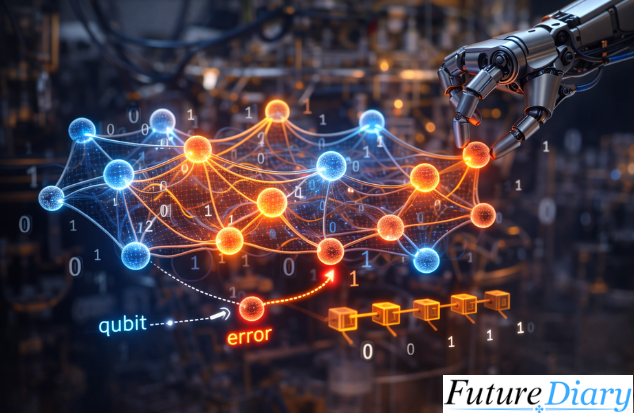
Quantum computing has been stuck in an awkward middle stage for a few years now. The machines are too noisy to be fully reliable, yet too powerful to ignore. That in-between zone even has a name: NISQ, which stands for Noisy Intermediate-Scale Quantum. And right in the heart of that challenge sits a concept gaining serious traction among researchers — s-nisq quantum error correction. It is not just a technical fix. It is a reframing of how we think about building reliable quantum systems without waiting for the perfect, fault-tolerant hardware that might still be decades away.
This article breaks down what s-nisq quantum error correction actually means, why it represents a smarter path forward, and what the latest research tells us about where this field is going. Whether you are a researcher, a tech-curious professional, or someone trying to make sense of quantum computing news, this is the guide you have been looking for.
How S-NISQ Quantum Error Correction Works in Practice
The practical implementation of s-nisq quantum error correction borrows from several established coding frameworks while adapting them to work under tight resource constraints. Surface codes are currently the most popular candidate, and for good reason. They only require nearest-neighbor interactions on a 2D grid of qubits, which maps well onto real chip architectures. They also have a relatively high error threshold, meaning the underlying hardware can be somewhat noisy and the code still works.
In a surface code setup relevant to s-nisq quantum error correction, you have data qubits interleaved with ancilla qubits. The ancillas are measured repeatedly to detect syndromes — signatures that indicate where an error may have occurred. The actual data qubits are never directly measured during computation, which preserves their quantum state. When a syndrome is detected, a classical decoder processes the information and applies a correction to the data qubits.
“The challenge is not just detecting errors. It is detecting them fast enough and correctly enough that the correction does not introduce more errors than it fixes.” — paraphrased from recent quantum error correction literature
The “scaled” or “suppressed” aspect of s-nisq quantum error correction comes from the fact that these techniques are being deployed on real, imperfect hardware with a limited number of physical qubits. Researchers are finding ways to encode logical qubits using fewer physical qubits than full fault-tolerant systems would demand, accepting a somewhat higher residual error rate in exchange for being able to run on hardware that actually exists today.
What Does S-NISQ Actually Mean?
Before diving into the error correction piece, it helps to understand the “S” in s-nisq quantum error correction. The term refers to “Scaled NISQ” or in some literature “Suppressed-Noise NISQ,” depending on the research group. The core idea is the same either way. Instead of assuming you have perfect qubits or infinite resources for full fault tolerance, s-nisq quantum error correction works within the real constraints of today’s hardware, aiming to suppress errors enough to make computations practically useful.
Standard NISQ devices operate with error rates that are too high for many meaningful tasks. Full fault-tolerant quantum computing, on the other hand, requires so much overhead in physical qubits per logical qubit that it remains out of reach for near-term hardware. S-nisq quantum error correction sits between those two realities. It uses partial error correction techniques, noise mitigation protocols, and smart circuit design to extract reliable results from noisy machines, without demanding the full overhead of fault-tolerant architectures.
The Problem With Quantum Noise
Quantum systems are incredibly sensitive. A qubit can be disrupted by temperature fluctuations, electromagnetic interference, even the act of measuring nearby qubits. These disruptions introduce errors in the computation, and those errors compound quickly as circuits get deeper. This is the central pain point that s-nisq quantum error correction is designed to address.
There are a few dominant error types that researchers deal with. Bit-flip errors change the state of a qubit from 0 to 1 or vice versa. Phase-flip errors alter the quantum phase of a qubit. And then there are more complex correlated errors that happen across multiple qubits at once. Each of these requires a different approach, and s-nisq quantum error correction has to handle all of them with limited qubit budgets.
| Error Type | Description | Correction Approach |
|---|---|---|
| Bit-flip | Qubit flips from 0 to 1 or 1 to 0 | Repetition codes, surface codes |
| Phase-flip | Quantum phase is disrupted | Hadamard-basis correction |
| Depolarizing | Random error in any axis | Stabilizer-based codes |
| Crosstalk | Adjacent qubits interfere | Circuit scheduling, dynamical decoupling |
| Measurement error | Readout inaccuracy | Repeated measurement averaging |
What makes s-nisq quantum error correction different from classical error correction is that you cannot simply copy a qubit to check it. Quantum mechanics forbids it through the no-cloning theorem. So researchers have to get creative, using entanglement and ancilla qubits to detect errors indirectly without disturbing the quantum state being protected.
Key Techniques Used in S-NISQ Error Correction
Several specific methods are central to what makes s-nisq quantum error correction work. Zero-noise extrapolation is one of them. The idea is to intentionally run a circuit at multiple noise levels, then mathematically extrapolate back to what the result would have been at zero noise. It sounds counterintuitive, but it works remarkably well for certain circuit types.
Probabilistic error cancellation is another method closely tied to s-nisq quantum error correction. By modeling the noise in a device as a probability distribution over error operators, you can run a series of circuits that collectively cancel out the noise effects. This requires more circuit executions, but no extra qubits. That tradeoff is exactly the kind of pragmatism that defines the s-nisq approach.
Symmetry verification is also gaining attention. Many quantum algorithms operate on states that should have specific symmetry properties. If the output violates those symmetries, something went wrong. S-nisq quantum error correction can use this as a post-selection filter, discarding results that are clearly corrupted without needing to identify the exact error that caused the problem.
Why S-NISQ Is Different From Traditional Fault-Tolerant Approaches
Traditional fault-tolerant quantum computing sets a high bar. It requires error rates below a specific threshold, a large number of physical qubits per logical qubit (sometimes hundreds to thousands), and classical control systems that can decode error syndromes in real time. Most current hardware simply cannot meet all three requirements simultaneously.
S-nisq quantum error correction takes a different bet. It accepts that you will not fully eliminate errors but aims to reduce them enough to make useful computations possible. The goal shifts from “achieve perfect logical qubits” to “get good enough results for the problem you are trying to solve.” For many near-term applications in chemistry simulation, optimization, and machine learning, good enough might actually be sufficient.
This is not a compromise born of laziness. It reflects a mature understanding that different computational tasks have different error tolerance thresholds. Running a financial optimization with a few percent error might still give actionable results. S-nisq quantum error correction enables those applications to move forward on today’s hardware.
The Role of Classical Computing in S-NISQ Error Correction
One thing that often gets overlooked is how heavily s-nisq quantum error correction relies on classical computing. The quantum device is only part of the system. Behind it sits a classical processor that tracks error syndromes, runs decoders, and often performs variational optimization as part of hybrid quantum-classical algorithms.
In real-time implementations of s-nisq quantum error correction, the classical decoder has to operate fast enough to keep up with the rate of syndrome measurements. This is a genuine engineering challenge. If the classical side is too slow, errors accumulate faster than they can be corrected. A lot of current research is focused on training neural networks and other machine learning models to act as fast decoders, bringing down the latency to acceptable levels.
The hybrid nature of s-nisq systems also means that algorithmic design matters enormously. Quantum circuits that are shallow, structured, and noise-aware tend to perform far better than circuits that were designed for ideal hardware and then run on noisy machines.
Recent Progress and Research Directions
The field has seen meaningful progress over the past few years. Google’s Sycamore processor demonstrated that below-threshold error correction is achievable with surface codes, which was a milestone for s-nisq quantum error correction in practice. IBM has been steadily increasing qubit counts and improving coherence times, moving closer to the regime where s-nisq approaches can deliver practical advantage.
Academic research has also moved fast. Groups at MIT, Caltech, and various institutions in Europe and Asia have published results on new decoding algorithms, improved syndrome measurement schemes, and circuit optimization techniques tailored to s-nisq quantum error correction. The development of more efficient belief-propagation decoders and neural-network-based decoders is particularly promising for the near term.
| Milestone | Year | Significance for S-NISQ |
|---|---|---|
| Logical qubit lifetime exceeds physical qubit | 2023 | Validated error suppression in hardware |
| Real-time syndrome decoding below 1ms latency | 2023-2024 | Enabled practical error correction cycles |
| 1000+ qubit chips announced by IBM | 2023 | Gave s-nisq techniques room to scale |
| Neural decoder matching MWPM at 10x speed | 2024 | Reduced classical bottleneck significantly |
| Hybrid variational error mitigation on 100+ qubit circuits | 2024 | Extended applicability to larger algorithms |
Applications That Benefit From S-NISQ Error Correction
Not every quantum application needs perfect error correction. Many are already positioned to benefit directly from s-nisq quantum error correction because they can tolerate some residual noise while still outperforming classical approaches.
Quantum chemistry simulation is probably the most compelling case. Calculating molecular ground state energies is important for drug discovery and materials science, and even approximate results with well-characterized error bars are useful to researchers. Variational quantum eigensolvers, when paired with s-nisq quantum error correction and noise mitigation, are showing genuine promise for small but chemically relevant molecules.
Optimization problems in logistics, finance, and network design are also candidate applications. Quantum approximate optimization algorithms (QAOA) operate in a regime where s-nisq quantum error correction can meaningfully extend circuit depth and improve result quality. Machine learning applications, particularly quantum kernel methods and quantum neural networks, are also being actively explored in this context.
Challenges That Still Need Solving
Honest reporting requires acknowledging the obstacles. S-nisq quantum error correction is not a solved problem. One of the biggest ongoing challenges is scalability. As the number of qubits grows, the overhead for error correction grows with it, and the classical decoding problem becomes harder. Keeping this manageable while maintaining real-time performance is still an open engineering problem.
Qubit connectivity is another constraint. Not all qubit pairs on a chip can interact directly, which limits how easily you can implement the entangling gates that error correction requires. Compiler and scheduling tools are improving, but it remains a friction point for deploying s-nisq quantum error correction on larger circuits.
There is also the challenge of verifying that the error correction is actually working as intended. On a classical computer, you can simulate what should have happened and compare. On a quantum device large enough to demonstrate quantum advantage, that classical simulation is no longer tractable. Researchers need better benchmarking tools to assess the real-world performance of s-nisq quantum error correction at scale.
What the Future Looks Like
The trajectory of s-nisq quantum error correction points toward a gradual convergence with full fault tolerance as hardware improves. The techniques being developed now will not be thrown away once better qubits arrive. They will feed directly into the design of fault-tolerant architectures by informing which codes are most practical, which decoders are fastest, and which circuit structures minimize error propagation.
In the near term, the most likely path forward involves hybrid systems where s-nisq quantum error correction handles the quantum portion of a computation while powerful classical processors handle everything else. This is already the dominant paradigm in quantum algorithm development, and it will likely remain so for at least the next five to ten years.
The researchers who are building and refining s-nisq quantum error correction today are essentially writing the manual for how quantum computing will actually be used in practice before ideal hardware arrives. That work is unglamorous compared to announcements about qubit counts or quantum supremacy experiments, but it is arguably more consequential for near-term impact.
Conclusion
S-nisq quantum error correction occupies a critical and often underappreciated position in the quantum computing landscape. It bridges the gap between the noisy devices we have today and the fault-tolerant machines we are working toward. By accepting real-world hardware constraints and designing error suppression strategies that work within them, s-nisq quantum error correction is enabling quantum computers to do useful work right now, not in some distant future.
The techniques being developed under this umbrella, from surface codes and zero-noise extrapolation to neural network decoders and symmetry verification, represent some of the most practically grounded work happening in the quantum field. Progress is real, benchmarks are improving, and the applications that stand to benefit are genuinely valuable. For anyone watching quantum computing closely, understanding s-nisq quantum error correction is not optional. It is the key to understanding where this technology actually stands and where it is heading.
Frequently Asked Questions
What exactly is s-nisq quantum error correction and how is it different from standard error correction?
S-nisq quantum error correction is a set of techniques designed to reduce and manage quantum errors on near-term noisy hardware, without requiring the full overhead of fault-tolerant quantum computing. Standard quantum error correction, in its ideal form, aims to completely suppress errors below any desired threshold by encoding each logical qubit across many physical qubits and running continuous error detection cycles. S-nisq quantum error correction instead works within the real constraints of today’s devices, using partial encoding, noise mitigation methods, and hybrid classical-quantum approaches to get useful results from machines that are still imperfect. The key distinction is pragmatism: s-nisq quantum error correction optimizes for what is achievable now rather than what is theoretically perfect.
Why can’t quantum computers just use classical error correction methods?
Classical error correction works by copying information and comparing copies to identify errors. Quantum mechanics explicitly forbids copying an unknown quantum state, a principle known as the no-cloning theorem. This means s-nisq quantum error correction has to use fundamentally different strategies. Instead of copying qubits, it uses entanglement between data qubits and ancilla qubits to detect whether errors have occurred without directly measuring the quantum state being protected. The information about errors is encoded in the correlations between qubits, not in any single qubit’s value. This requires specialized quantum codes like surface codes, and it is one of the reasons s-nisq quantum error correction is such an active research area.
What hardware is best suited for s-nisq quantum error correction right now?
Superconducting qubit platforms, like those developed by Google and IBM, are currently the leading candidates for implementing s-nisq quantum error correction. They offer relatively fast gate speeds, decent coherence times, and 2D connectivity layouts that map well onto surface codes. Trapped ion systems are another strong option, with lower error rates per gate and full connectivity between qubits. Photonic quantum systems are also being explored but face different challenges. For s-nisq quantum error correction specifically, the ideal platform combines high gate fidelity, low measurement error, fast readout, and real-time classical control.
How does s-nisq quantum error correction handle measurement errors?
Measurement errors are a genuine problem because measuring an ancilla qubit to detect an error syndrome can itself introduce errors. S-nisq quantum error correction handles this through repeated syndrome measurements over multiple rounds. A single measurement result is not trusted in isolation. Instead, patterns of syndrome measurements over time are analyzed to build a consistent picture of what errors have occurred. This spatio-temporal analysis is part of what makes decoders in s-nisq quantum error correction computationally intensive. Modern surface code decoders treat measurement errors and gate errors with comparable weight, using minimum-weight perfect matching or neural network approaches to find the most likely error scenario consistent with the observed syndrome history.
When will s-nisq quantum error correction enable genuinely useful quantum advantage?
This is the question everyone in the field is asking. The current state of s-nisq quantum error correction suggests that for specific, well-chosen problems like small molecule chemistry or certain optimization tasks, demonstrations of practical advantage on near-term hardware could arrive within the next three to five years. These will likely be narrow wins in specific domains rather than a broad general advantage. For s-nisq quantum error correction to underpin widely useful quantum computation, qubit counts need to scale further, error rates need to drop another order of magnitude, and classical decoders need to get faster. Progress on all three fronts is ongoing, but the timeline to broadly practical quantum advantage remains genuinely uncertain.
